Your 'Nomad-Friendly' Hotel Might Be Lying to You: 6 Amenities That Separate the Real Ones From the Posers
Every resort on the internet claims to be nomad-friendly these days. It's the hospitality equivalent of 'artisanal' — a word that's been stretched so thin it barely means anything anymore. But here at Nomad Resort X, we've spent enough time watching remote workers land, unpack, and immediately hunt for a flat surface that isn't a beach towel to know the difference between a real workation property and a hotel with a marketing budget.
So let's cut through it. These are the six amenities that actually matter — and the red flags that should make you close that booking tab.
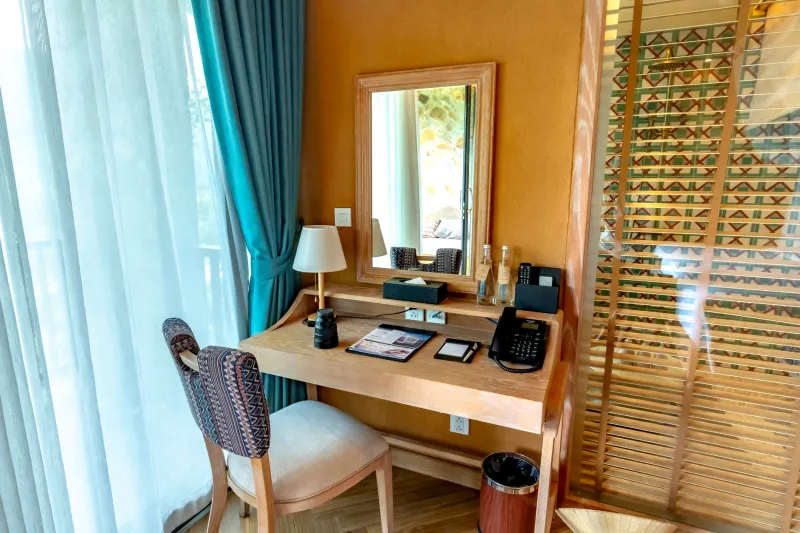
1. A Desk That Was Built for a Desk
Not a dresser. Not a dining table shared with a family of four from Ohio. An actual workspace — ideally ergonomic, definitely dedicated, and positioned near a window if the property knows what it's doing.
Why it matters: Your lower back is keeping score. Eight hours a day hunched over a wobbly nightstand adds up fast, and 'I'll just work from the bed' is how a two-week workation turns into a physical therapy bill.
Red flag: Photos of the room that conspicuously avoid showing the workspace. If they won't show you the desk, the desk is a lie.
2. Phone Booths (Yes, Actual Ones)
You will have a 9 a.m. standup. Your teammates in Denver do not want to hear the waves — or worse, the pool DJ. A proper nomad resort gives you soundproof call rooms you can book by the hour, so your Zoom background stays professional even when your afternoon plans involve a hammock.
Why it matters: Nothing kills a promotion faster than being the person whose audio is 'a little echoey' on every call for three months.
Red flag: 'Quiet zones' that are really just a corner of the lobby. That's not a call room, that's a suggestion.
3. Wi-Fi With a Résumé
Everyone advertises fast internet. Almost nobody advertises backup internet. The real ones have redundant lines — ideally from two different providers — so a single cable cut on the island doesn't turn your Tuesday into a hostage situation.
Why it matters: Your livelihood depends on this connection. Speed is nice; reliability is everything.
Red flag: 'Up to 500 Mbps' with no speed test screenshots, no recent reviews mentioning video calls, and no backup plan mentioned anywhere. Ask directly. Watch how they answer.
4. Wellness That Fits Your Calendar, Not the Other Way Around
A sunrise yoga class is lovely — if you didn't take a 6 a.m. call with the East Coast. Workation-focused properties program wellness throughout the day: mid-morning stretch breaks, evening recovery sessions, a gym that opens early for the early-bird crew.
Why it matters: The whole point of a workation is that work and life actually coexist. Wellness programming that assumes you're on vacation misses the assignment entirely.
Red flag: A single 7 a.m. yoga class and a spa menu priced like room service at an airport hotel.
5. Community Without the Forced Fun
The best nomad resorts engineer serendipity: communal dinners, coworking spaces where people actually talk to each other, weekly events that don't require you to be 'on.' The worst ones either feel like a dorm or a cruise ship. You want the middle — enough energy to meet people, enough quiet to ship your sprint.
Why it matters: Long stretches of remote work get lonely, and the friends you make at a good workation property often become the colleagues, clients, and travel partners of the next decade.
Red flag: Events every single night. You're there to work, remember?
6. Long-Stay Pricing That Isn't a Scam
If a property really wants nomads, their weekly and monthly rates should reflect it — not a token 10% off the nightly rate. Real workation properties build their business model around longer stays, and it shows in the math.
Why it matters: The difference between a token discount and a genuine long-stay rate can be $1,000+ over a month. We break down exactly how to run those numbers in our long-stay pricing guide.
Red flag: 'Monthly rates available upon inquiry.' That usually means there's a reason they don't publish them.
The Bottom Line
A nomad paradise isn't a hotel with good lighting. It's a property designed around the reality that you'll spend half your day working and want the other half to be worth the flight. Check the desk, test the Wi-Fi, count the call rooms — and book the place that gets it.